
More and more often, there is this quiet but persistent tightening under my ribs when I look at young people. It does not come from fear, but as if I am seeing my own shadow in someone I do not know.
I walk into a café. Next to me sits a boy, maybe seventeen. He touches his phone as if he is holding an oxygen dropper. His thumb keeps scrolling, but his eyes remain still – as if he is carrying out someone else’s command. Sometimes he flinches, sometimes he smiles, but somehow by force, and sometimes he freezes completely.
And I catch myself thinking:
“He is around seventeen, but his nervous system is forty-five.”
Not because his life is full of battles and stress, but simply because his personal world is overloaded at the entrance and empty at the inner exit.
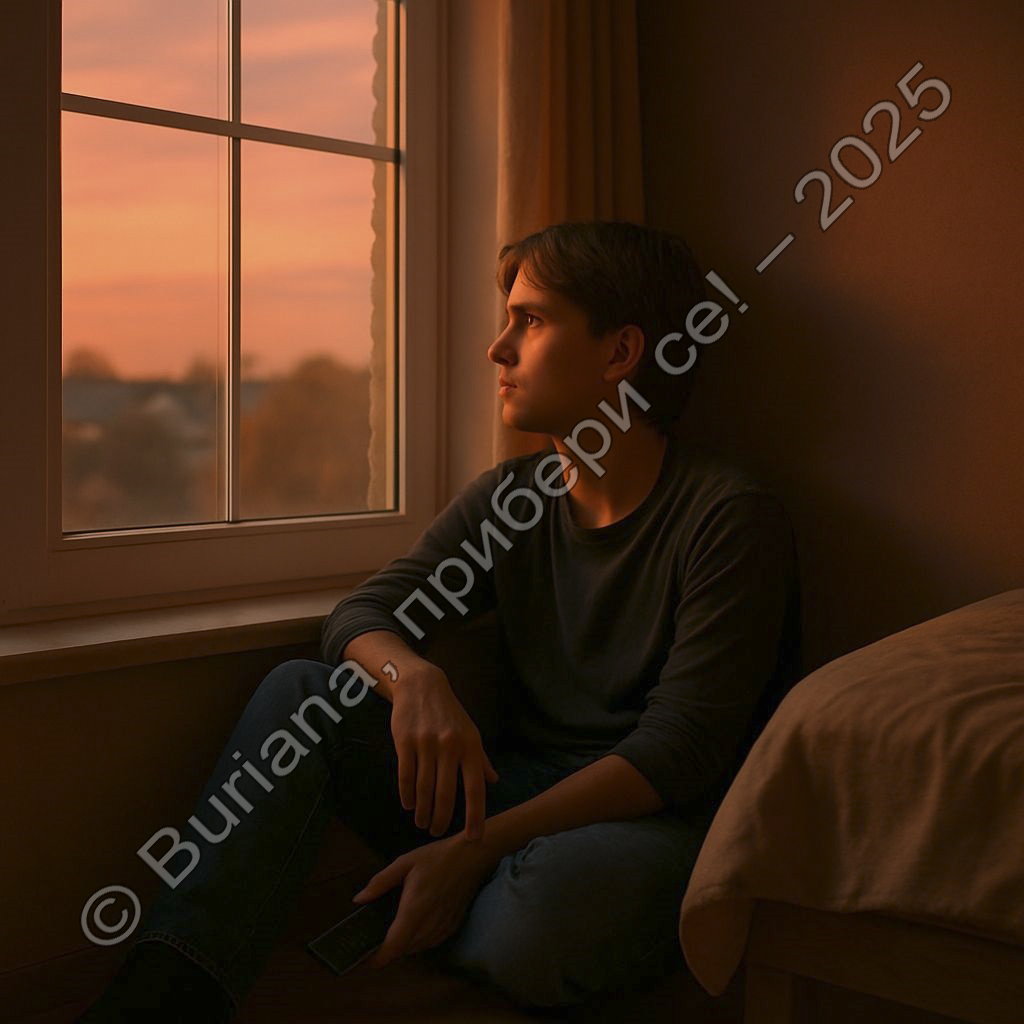
When you do not hear yourself, you hear everything else
Many young people do not know who they are. The reason is not a lack of character, but because they lack silence in which to hear themselves. Their identity has formed not in its own rhythm and pace, but in the pauses between two notifications.
And notifications are persistent teachers – constant and completely indifferent to your soul.
Eli, a student, says:
“I just cannot be with myself. This… thing starts in me. And I begin looking for distraction.”
This “thing” is a sudden inner surge of anxiety and tightness – as if your own skin becomes too small, your thoughts scatter, and the body automatically reaches for any distraction at all: phone, series, chat, work, Red Bull, cigarette…
I do not remember hearing a more honest sentence about a lost inner connection. Where this “thing” begins, in fact, should be her home.
And once it was different
It was not better, but it was quieter. There was time for the body, for boredom, for slowing down.
There was space between words – a space in which a person did not compare themselves, but sensed themselves.
Now the “self” is constructed as a project, not as an experience. And if someone gets lost, the algorithm finds them before they have even moved.
And offers them a new face, a new role, a new world in which they can hide from themselves.
But a person is born with an inner world. When that world is deafened from outside, the young person begins to believe that something is wrong with them. In fact, everything is all right; they are simply overloaded.
For example, Maya, whom I met on the bus.
She was sitting alone, with a hood that hid half her world. Her phone was lit up, but she was not looking at the screen. It was as if she were holding it like a talisman against her own thoughts.
When the bus jolted, she gripped the phone as if it were her greatest support, holding her so she would not fall. And then… she cried without a sound. In her tears I read:
“I am crying because I have no thread to hold on to.”
Sometimes a person cannot say “why.” They can only say, “I do not know how.. I cannot go on like this anymore.” And even that they say only in their mind.
Nikolay – Koko, on the other hand, is eighteen and lives with the feeling that everyone else has a map of the world, and only he was given a blank sheet. I asked him what he wanted. He looked at me for a long time, as if he expected the answer to appear on my forehead. Then he said:
“Many things… , but I do not feel any one of them as mine.”
This is a generation with thousands of possibilities, with a sea of choices and a weakened inner sense of direction; their compass has no arrows. And this is not confusion, but a lack of a stable point of departure, a lack of a place from which to begin.
Being alone with many choices is sometimes much heavier than being alone without a choice.
A girl was sitting in front of the entrance to the store. Without a phone – that was the first thing that impressed me. Her eyes were fixed on one point, as if she were returning to her body after a long walk outside it.
I decided to ask her whether she was waiting for someone. She smiled crookedly and said something as if she had poured hot water over me:
“Myself. But I think I am late…”
This is a phrase you cannot invent. When did this soul become so tired…
And we, the adults, what do we do?
Sometimes we compare them with ourselves: “Our generation was not like that…”
It was not. But not because we were stronger, but because the world was quieter.
There were gaps in the days – real, human gaps, in which you could look at yourself. Now the gaps in their “I do not know who I am” are filled automatically: by constant movement, by sounds, by screens. The algorithm runs faster than any inner silence and fills it with other people’s lives, other people’s anxieties:
“Here is a goal for you, here is a body, here is a dream, here is a mood, here is a profession – choose something, it is on promotion too!”
The world enters through the screen so quickly that the young person finds it hard to distinguish their own desire from someone else’s well-lit shop window. And so they grow in an environment where the inner cannot be heard, and the outer does not stop speaking.
When you have no silence, you cannot hear yourself. When you do not hear yourself, you begin to mistake other people’s decisions for your own, and they have nothing to do with you.
And there comes a moment when a silhouette stands in the mirror, and inside it silence asks: ‘Who are you? Where are you?’”