
Part II: The Profile, Anxiety, and the Inner Center
(Reading time – 5 minutes)
In the first part, we saw the visible world of Z – the screen, the noise, the constant connection, the speed, the hunger for truthfulness, and the strange loneliness of a person who can be everywhere, but does not always find the way to themselves.
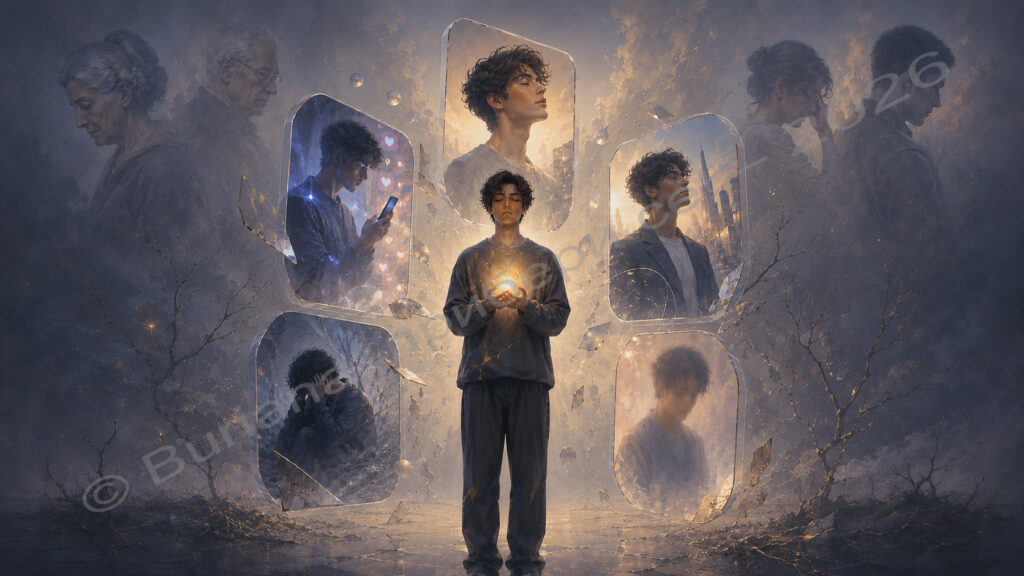
In the second part, we go beneath the surface – there, where where the profile is not simply a photo, but a temporary identity, and where anxiety is not “whining,” but often a signal that the inner system does not have sufficiently strong support. There, where the big question of Z is “Who am I when no one is watching me, no one is writing to me, and nothing is distracting me?”
Now we will “visit” the most characteristic inner blocking structures (IBS) – traumas, programs, convictions, beliefs, emotions, and reactions that live at a subconscious level and begin to govern our choices before we even understand that we have chosen. In Z, some of these IBS are personal – created by the current digital world, by school, family, the group, social media, constant visibility, and overstimulation. Another part is inherited, because every generation leaves a trace in the next through the way it loves, stays silent, controls, survives, works, runs away, saves, or proves itself.
BB leave the trace of fear, silence, and security at any price. X leave the trace of coping, function, and the rescuer reflex, and Y – the trace of image, meaning, the personal brand, and the pressure to be “something more.” Z receives all of this, and its own world adds one more layer: algorithm, visibility, comparison, reaction, anxiety, and the temptation to experience itself through the gaze of others.
Fundamental IBS: Program “I Do Not Know Who I Am When Everything Falls Silent”
It is not always like a clear thought. More often it is felt as restlessness, emptiness, irritation, the need to immediately play something, hear a sound, open an app, check who has written what, do something with the hands, with the eyes, with the attention.
Z learns very early not to remain alone with itself for long. Even in childhood, boredom is often filled with the screen, loneliness – with chat, tension – with a clip, and waiting – with scrolling. The inner feeling does not get time to form, because a new stimulus is constantly entering from outside. The child first asks “what is happening outside,” and not “what am I feeling.”
To this personal layer we can also add inheritances from the predecessors. BB often did not have a language for the inner world. X learned to be useful instead of asking how they were. Y already begins to talk about feelings, but often translates them through image, story, development, mission. In fact, Z inherits an underdeveloped connection with the inner world, but lives in an environment that carries it even further outward.
Living example: Viki, a girl of 17, comes home from school. It has been a tense day, but she cannot say exactly why, because nothing “big” has happened. There is no drama, no one has openly offended her, there is only a feeling of heaviness. She goes into her room and immediately plays clips – three or four. After an hour, she has already watched a bunch of different things, laughed, gotten angry, compared herself, saved two ideas, replied to several messages. The heaviness is still there, even denser. Because it has not been heard, but drowned out.
This IBS leads to behavior of constant distraction and to difficulty for a person to remain in silence. To the feeling that rest is emptiness, in which you lose yourself, not recovery. To choices made from outside inward: “what are others doing,” “what is normal,” “what looks good.” “What is mine?” is missing.
The inner center begins to be built in exactly the opposite way. Precisely with small moments in which a person does not run away from themselves. There is no need for a heroic shutting off of the whole world for three-seven days, because with Z this often leads only to panic and a dramatic return to the scroll. But small living pauses – minutes or an hour without a phone in the morning, a walk without headphones, one honest answer to the question: “Today inside me there is…”
Program: “If I Am Not Visible, I Do Not Exist”
Very characteristic of the time of Z. Visibility is an everyday environment; it is no longer only for famous people. Everyone can be watched, assessed, liked, passed over, compared, commented on. When a person grows up in such an environment, they easily begin to confuse presence with display.
The personal layer is created by social media and the culture of groups. If you post, you are in the trend, which means you exist. If you do not post – it is as if you are outside what is happening. If your photo has no reactions, inwardly it may sound: “something in me is not worth anything.” If someone else receives attention, the old human envy no longer passes through the neighborhood fence, but through the screen in high resolution.
The inherited layer comes strongly from Y, but more deeply it begins even before that. With BB, identity was often a role: a good worker, a good parent, a decent person. With X, it often becomes a function: the one who holds, carries, fixes, saves. With Y, it turns into an image: a person with a mission, style, project, direction, story. With Z, the image becomes even faster and more disintegrating: today I am this, tomorrow I am something else, the day after tomorrow I have to rewrite myself again.
Living example: Mario is 19, he is not an influencer and does not want to be. He even jokes and is sarcastic and ironic with “those who live for likes.” But when he uploads a photo and it does not receive the expected reactions, his mood drops sharply. He does not say: “I have no worth,” but “That was stupid, why did I even upload it.” and deletes the photo. And after that he behaves slightly cynically toward everyone who posts. Cynicism is actually a super-convenient armor. Beneath it stands pain: “I wanted to be seen, but I am ashamed that I care.”
This program is a program for constant editing of oneself. A person begins to choose not only clothing and actions, but a version of themselves. It is not important only to have an opinion, but a position that looks right. And it is not the experience that matters, but the frame that can be shown. It is possible for Z to become very good at looking authentic, but in fact not always know how to be real when alone with themselves.
The inner center here is built by returning to the experience before the showing. To do something because I desire it and not to post it. To like a piece of clothing that is not an “aesthetic,” but is simply comfortable for me. To have an opinion that has not yet been filtered for the stage. And above all, to admit that I want to be seen, without that becoming shame, because the need to be seen is human. This is not the problem; it begins when the gaze of others becomes the only mirror.
Program: “If I Am Not Connected, I Will Fall Apart”
Constant external connectedness is beautiful when it creates closeness and becomes dangerous when it begins to replace inner connectedness.
The personal layer comes from the habit of the nervous system calming itself through an external signal. Someone writes to me, reacts – so I am not alone, I matter. When the phone is silent, silence is not felt as peace, but as abandonment.
The inherited layer comes from the old forms of emotional lack. BB often loved through care, but not through conversation. X grew up independent, but internally unseen. Y began to seek more emotional communication, but often remains anxious and shaken. Z inherits the hunger for connection, but in a world that offers a lot of contact and less real presence.
Living example: Today I stopped by a neighbor girl of 17, in the little garden in front of the entrance. She was clenching her teeth, her nostrils were trembling, and she emitted high voltage that shook me. She had written to a friend and there had been no answer for ten minutes. Objectively, this is nothing. But inside her a storm was raging: “Is she angry with me? Did I write something stupid? Am I no longer important to her? She is probably with the others.” I could see how, after every explanation to me, the girl became cold, offended, and even passive-aggressive. In her, silence was translated as rejection.
This IBS leads to clinging, anxious relationships, fear of exclusion, panic at the lack of an answer, the need for constant checking. In love it can lead to relationships in which there is no real closeness, but there is constant control: “Where are you? Why didn’t you answer? Who are you with? You saw it, but didn’t write.” In friendship it can lead to dramatic breaks because of small signs, and in the family – to closing down, because live conversation is harder than chat.
The inner center here is built through the ability to remain connected with myself while the other is absent. Not “I don’t care,” but not to fall apart immediately and to be able to say: “Now my fear has been activated, but in fact I have no fact.” The big step for Z is to distinguish fact from inner storm.
Program: “I Cannot Endure Tension, I Must Immediately Remove It or Postpone It”
With BB, tension is clenched; with X, it is carried; with Y, it is analyzed, narrated, or translated through meaning. With Z, it is something that must be reduced immediately. Immediately.
The personal layer comes from overstimulation and from easy access to quick relief. When I am bored, I put something on. If I am anxious – I scroll. If I am lonely, I write in the chat or messenger. When this “escape” becomes the only model, a person cannot develop an inner capacity to bear feelings and emotions.
The inherited layer comes from generations also lacking healthy regulation, only they covered it up in another way. BB – “grit your teeth,” X – “there is no time, act,” Y – “understand your trauma.” Z says: “I can’t, it is too much.” And if it remains only in this “I can’t,” life begins to shrink around the avoidance of discomfort.
Living example: A student has an exam. He is not completely ready, but he is not unprepared either. He can study for two more hours, but instead he opens the phone “just for a little while.” Then it gets late, the tension grows, and guilt appears. The next day he may not even go to the exam. From outside it looks like laziness, not caring. From inside it is often something else: “If I go in and do not manage, I will collapse. It is better not to show up than to fail.”
This program is a source of postponement, escape, abrupt cutting off of relationships, avoidance of difficult conversations, refusal of opportunities that carry risk. It also leads to excessive classifications: “this is toxic,” “this is a trigger,” “I cannot tolerate this energy,” when in reality the truth is simpler – “this is hard, and I still cannot stand in the hard.”
The inner center here is built through dosed tolerating, but not through violence against oneself and the old “come on, pull yourself together.” Let these be small meetings with tension: I stay in the conversation for two more minutes, I finish a task even though it is unpleasant, I admit fear without immediately running away, I wait for an answer without writing another five messages. Resilience is grown and trained like a muscle – slowly, sometimes annoyingly, and with more repetitions than we would like.
IBS: “If I Choose, I Will Shut Myself into the Wrong Life”
Z has so many choices that choice sometimes begins to look like a trap. What to study, what work to choose, should I stay, should I leave, should I have a relationship, should I start a project, should I commit to a direction, or should I wait a little longer until I “feel what is mine”?
The personal layer comes from the space of infinite possibilities. Every decision looks temporary, because there is always something else. More courses, more options, one more profession, one more identity. And if everything is possible, every choosing looks like a loss of the rest.
The inherited layer comes strongly from Y, from the great promise of “something more.” But it also comes from X, who experienced how one system collapses and how professions, security, and plans can turn out to be unstable. Deep in family memory stands the message: “be careful what you choose, because tomorrow the world may be different.”
Living example: Nikoleta, 23, has an interest in psychology, design, foreign languages, and social anthropology. Instead of this being richness, it becomes torment. She starts a course, then stops it, because perhaps it is not “hers.” She starts a job, but after a month asks herself whether in this place she is not wasting her potential. She likes a person, but does not truly enter into a relationship, because perhaps she will meet someone more suitable. Her life is not empty, but it is unfinished, because every direction is experienced as a danger of missing the true one.
This IBS leads to the postponement of growing up, to many things begun and few embodied. It gives rise to fear of commitment, creates an inner feeling that a person is constantly preparing for life, but not living it. Sometimes Z looks as if it does not know what it wants, but this may be fear that if it chooses, it will turn out to be wrong.
The inner center here is built through understanding that choice is only a step, the next honest move. Not every direction has to be fate. It is important for Z to stop searching for the guaranteed right life and to begin building a real life through small, verifiable choices.
Z is not the “spoiled generation,” as it is often conveniently called by people who have not lived a single day with an algorithm over their head and an invisible audience in the room. The question is not to compare whether Z is weaker, more anxious, or more distracted than the previous generations. It is more important to understand what happens to a person when the outer world becomes faster than their inner growing up.
We will continue with this in the third part, with more characteristic IBS, those that stand behind the flight from body and presence, the difficulty with real closeness, and that quiet inner hunger for meaning, which cannot be fed either with likes, or with notifications, or with the next “just one more clip.” Because beneath all this noise there is something that does not simply want to be seen, but to be found.
(To be continued)
If you come across words in color in the text – they are links to additional materials on the site related to similar topics.