
(Reading time: 4 minutes)
The road from Florence to Livorno was like an afterword to the encounter with David – long, with roadworks, traffic, and several of Boni’s songs, sung out of tune, but with enthusiasm.
– I feel like an Adriano Celentano song – she shouted, spreading her arms through the window.
The port of Livorno welcomed them with the smell of the sea, mixed with diesel and hopes for a better day. They passed by fish stalls, gesticulating people, and cats that looked more confident than most politicians. Sen calculated the best ferry and got them on board on time.
There was a strong wind on deck. Boni spread her scarf like a flag and declared:
– The wind of change is blowing through my hair!
– And through your head? – Reni giggled.
– Full Napoleon. I have no room for small thoughts.
Bu was leaning against the railing and looking toward the island.
– You know – she said. – When Napoleon was exiled here, the first thing he did was to start reforms. He widened the roads, introduced sewage, raised an army. Even on Elba he had to control everything.
– Because he did not know how to be small – Reni muttered.
– Because he believed his worth came from governing – Bu added. – And perhaps… because he was afraid of what he would discover if he simply stayed with himself.
– Elba – the island of inner exile – Boni said, pretending to be a Shakespearean witch. – Or the island of the tyrant who does not want to take a break.
– How often we do the same – Bu grew philosophical. – We control, we plan. We tune everyone around us, because somewhere deep down we believe that without us everything will fall apart. And actually, we are simply afraid that we will be left alone with ourselves, without a function and without a mission.
– And then the inner Napoleon appears – Reni added. – Small, noisy, and always dissatisfied.
– And the funniest thing is – Boni joined in – that when I imagine him, he always wears pink slippers.
– Slippers, dear God?! – Reni cried.
– Yes. A dictator in slippers. That is why he is frightening; you do not notice him right away.
Bu laughed. She was looking at Elba, but in her mind a strange image of herself took shape – with a crown of habits and a scepter made of to-do lists. She felt how heavy that image was and decided she would let it go.
– Sen? – she whispered.
– I am here.
– Add the topic of the Inner Dictator to my program. Working title: “He Is Not Tall, but He Shouts Loudly.”
– Saved. I also suggest a subtopic: “The Slippers We Put on the Soul.”
Elba welcomed them with blue sky, the scent of wild rosemary, and a peaceful rhythm that could have made even Napoleon trim his toenails and lie down in a hammock. As they got off the ferry, Bu remembered another hero who had passed through here, although in literature – the young Edmond Dantès, who had once received a letter from Napoleon himself on Elba. He was not a Bonapartist and he was not guilty, but fate gave him another role – to turn into the Count of Monte Cristo, the avenger with endless pain and a bleeding heart hidden behind the glitter.
“Sometimes – she thought – it is precisely on small islands that the greatest metamorphoses are born. Edmond left from here with hope, passed through hell, and returned with wisdom. Inside ourselves, all of us are, more or less, Dantès before we become Monte Cristo.”
The car was climbing the hills above Castellina.
– I have arranged everything – Boni said confidently – I ordered a typical Tuscan atmosphere, everything to be local and with many of the local customs and manners, the food homemade, organic, and authentic. Sen confirmed it for me, so you can ask him.
– Sen?! – Bu asked suspiciously. – He is still in “penance” after the pasta with yogurt.
– Sen, confirm the order – Boni insisted.
– Confirmed. Location: Borgo San Michele – “The Home of Living Tradition.” Client: Boni. Expected atmosphere: rustic – typically rural.
– There, you see! Trust is everything – Boni declared.
When they reached the place, the door of the borgo opened and an elderly woman in a black dress and a netted shawl on her head stood on the threshold. She welcomed them with the words:
– Finalmente (Finally)… are you the new guests, such young beauties? Don Ernesto would have been delighted.
The three looked at one another. Bu whispered:
– That sounded like the beginning of a crime novel.
– Or a dinner with ghosts – Reni added.
– Come in – the grandmother insisted. – Sit down. We have eggplant soup. He loved eggplant so much…
A table was set under the vine arbor. Five plates and five sets of cutlery.
– Excuse me… are you expecting someone else? – Buryana delicately probed.
– Oh, no, only you. But I always leave a place for Don Ernesto. He still has dinner with me.
– In what sense? – Reni whispered.
– Do not ask! – Boni hissed. – Eat and thank her for these delicacies on the table.
After the soup came lentil meatballs, lasagna with zucchini, something that looked like veal in orange sauce, and finally lavender cheesecake. Everything was delicious and quite charged with history.
– He loved to sing, you know? – Grandma Dinora said, wiping away a tear. – Every time he opened a bottle of Chianti, he sang “O sole mio” with his mouth full of salami.
– Do you by any chance have another bottle of Chianti left? – Boni asked, her eyes shining.
– Oh, not here – he drank them, and I do not drink. There is Chianti at my grandson’s winery, which is literally two minutes away. I often say that Ernesto has been reincarnated in him, only with better teeth.
– Could you give us directions? – Buryana asked with an angelic smile.
– Of course. Say that you come from me and they will receive you as their own.
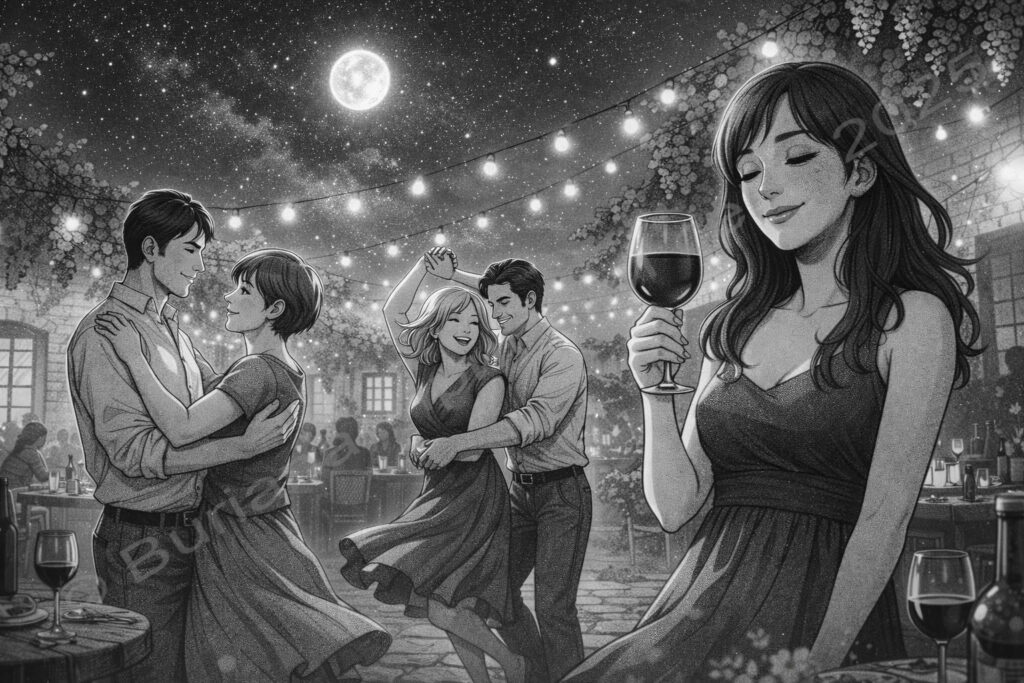
Half an hour later they were already dancing to the sound of live music – violin, accordion, and a voice that tore through the night like the shirt of a passionate Italian. Local men with rings, smiles, and the scent of basil were spinning our heroines to the rhythm of life, and the glasses overflowed in ruby.
Buryana, with a glass in her hand, whispered:
– This is it – this is what I want, here and now. Both order and chaos, and someone who dances beside you without asking “where are we going?”
She took a sip. First, that red-black-earthy breath pierced through her, in which there was ash, sun, and past. Then came the fruity thread. There was something tart and untamed in it, something that flirted and did not flatter. Chianti does not want you to like it; it knows its worth. Chianti gathers you together, makes you taste the sunset and admit something to yourself: “I’m sorry” or “I love you.” Or to someone you have lost in the hills between one meeting and one postponement. Chianti is not for everyone. It is for those who do not rush, who carry within themselves the ageless “yes” to life, even when it hurts. If she were wine, she wanted to be like it. A wine that not everyone likes, but that remains in the memory of those who know how to feel.
– Where are we going? – Reni shouted from the other end of the dance floor.
– Shopping – for a borgo! – Boni roared. – We are going to buy a borgo! But only if the neighbors are singers, winemakers, and wear white shirts with no buttons!
The moon was full, silver, poured over the vineyards like a promise. The wind carried the scent of rosemary, roasted peppers, and slightly smoked wood.
Buryana stepped away from the dancing for a moment and leaned against the stone wall of the old farm – barefoot, with the glass stuck to her hand, with a breeze in her hair, and this song… it was not simply playing, it came like a voice from the body of the earth itself.
She closed her eyes and through her head passed her first attempts to be “enough.” The first tightenings in her chest when someone had not chosen her. The times when she chose not to reveal herself. As if love had been a test you had to pass, not a gift you could embrace. All her conversations about love had been explanations, pleas, expectations. Or battles in which, for protection, she had words like a helmet and armor. No one had spoken to her like this – simply, quietly, with a voice that does not want, but is present. That does not change, but sees.
“Parlami d’amore… He is not singing – he is touching me. There, where even I have not reached. With his voice, with his breath, with the quiet certainty that I can let go. I do not know how to dance this song. It has no rhythm, it has a pulse. I close my eyes and the world disappears. Only his voice remains, and my chest, rising with something that has been and still lives in me.
“Parlami d’amore… Tell me about love. About the one you have given to no one. About the one you have held back. Tell me quietly, so that I can bear it. Every word rocks me. Toward a place in me that I have hidden behind strength. Behind that: I manage, I know the way, I do not need anything.”
“Parlami d’amore… Speak to me, because in this moment I am empty, but alive. And I can accept everything you have kept silent. Not to hurry, not to judge, not to want, to listen, to be, to love myself.”
Morandi’s voice floated over them like a silk scarf and intertwined with her thoughts.
The dance was internal. Everything around her dissolved like wine left to breathe – the voice reached toward her like the memory of something that had never happened, but had always been there.
“I do not want to be loved as before. I want to be loved like this – quietly, truly, without words that try too hard.”
Then she laughed softly. She looked toward Boni and Reni – one was spinning with a local man who repeated “bellissima” to her in every pause, and the other was eating dessert straight from the plate of some maestro of dance.
The warm, slightly husky voice that did not ask was calling her:
“Parlami d’amore… Yes, yes… this is love. Where you are with people who want nothing from you – except for you to be alive. This is it! This is the dolce vita everyone talks about! Not a perfect life, but a tasty one, real. Messed up, funny, sudden, with color and aroma. With eyes that do not run away. With hands that catch you by the waist in order to spin you and make you feel that you are flying, not tying you down.”
Something inside her relaxed. That eternally searching sense of meaning, order, and justice stopped counting. Stopped pressing. Now, among people who did not know her, with wine on her lips and stars in her eyes, she felt that this was the true place for love: inside her. Her tenderness returned, the one she had once tucked away in the dark.
“The world does not need me to arrange it. It simply needs me to love it as it passes by me. Beauty is everywhere. In the broken rhythm, in the escaped plan, in the scent of Chianti and my tousled hair. In the love I have not yet met, but already feel, because I am ready to receive it.”
And now – here, in this winery, at the end of the day – after pasta, David, shadows of dictators, and Grandma Dinora – she was simply a woman with long hair, bare feet, and eyes full of reflections from the little lights on the vine arbor.
At that moment someone offered her a hand. Perhaps he was a local, perhaps simply another dancing stranger.
She stood up, smiled, and the whirlwind of the dance carried her away.
The End.
“Quest to Self” – Q2S is an author’s method for inner transformation. It is not about an “artistic path,” but about a system with a clear structure, verifiable steps, and practical actions that lead to lasting change, not temporary inspiration. Through Q2S, a person releases blocked energy and accumulated inner reactions in the subconscious, restores their nervous system, and begins to create their reality consciously. If this touches you, you can explore how the process works in the section “Quest to Self – Q2S.”