
Buryana was standing on the windowsill, her bare feet resting on the warm floor, and the slice of lemon in her tea was rocking like a boat in a light storm. She was waking up and listening to the silence between the words of the world. The citrus aroma made its way to her brain, and it switched into daily mode.
She startled and remembered the man without a name who passed by the bins every day with his head lowered – The Man in the Gray Coat – she had christened him. No one knew what his name was. Some time ago his house had burned down. A stove, forgotten on a winter night, had swallowed his entire life. And since then he had been moving around – now in a porter’s lodge, now in a storage room, now in someone’s yard where the door was slightly ajar. In the morning he rummaged through the bins, because food had to come from somewhere. People from the neighborhood gave him something – old shoes, a jar of lentils, she had even seen a bag with a boiled egg. She had also made him warm banitsa with a side dish of a forgotten cashmere sweater from her ex-husband.
Last night, even on the way home, she had been thinking about him, but she did not see him. When she got home, the thoughts were already a strong pressure in her chest. Something was pushing with force and wanted to come out. She took the notebook, and the words set off by themselves from the home of the soul and found their place on the page:
Hello!
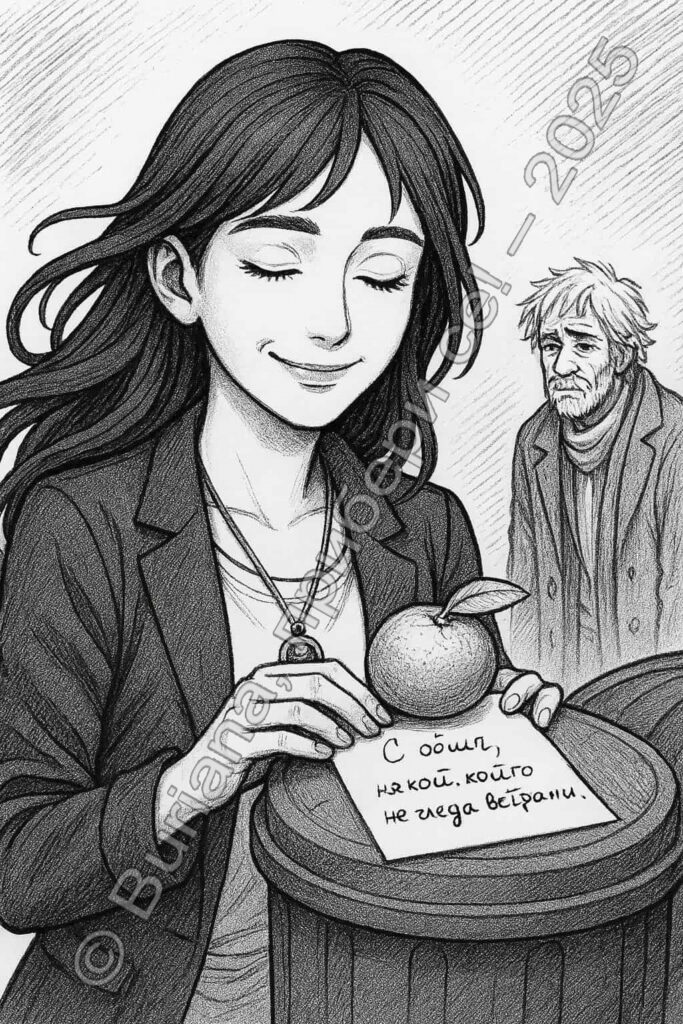
I know we do not know each other. I also know that you have probably seen all kinds of things on this bench – food, clothes, garbage, people who look away. And that is why, perhaps, this letter will seem the strangest of all to you. But sometimes, precisely the strangest things come from the most human place.
I want to tell you that I see you.
I do not see in you the person who “has no home,” nor the next one who “someone has to save.” I see you as a presence that endures. I see how the wind talks to your shoulders, how your eyes still remember the sky, even if they do not look for it on purpose. I see your hands as a story, not as a plea. And even if you do not say a word, I feel it – there is life in you.
I am not bringing you a promise, nor a recipe, nor a religion. I think that sometimes the things that hold us are not bread and shelter, but something quieter. Like someone whispering to you: “I see you.” And although I do not know exactly what you are going through, if one day you leave this bench, I hope you will take this with you – you are not invisible.
P.S. The tangerine is just a weight for the letter, so the wind does not carry it away if it becomes curious about what I am writing to you. But if you peel it, there is a chance the day will smell a little more orange and warm.
With love, someone who does not look away”
And she left them on the lid of the bin.
Oh! Had the letter reached its addressee?! Or had the wind really played with it. Impatience was itching her; she grabbed the half-empty garbage bag and put on her headphones. As she used to say, she “put them on like shoes,” because they, like Little Muck’s slippers, carried her from world to world.
The tangerine had disappeared, and so had the letter.
Bu smiled. Today the bins were empty, and by the wall there lay a piece of an old newspaper page, carefully folded. On it, in trembling, crooked handwriting with a pencil:
“The days are lighter when someone reflects themselves in you”
Beside the note there was a tangerine peel, crushed and still fragrant.
The space between her heart and lungs became wider. She felt how the soul stretched, recognizing itself in someone else’s pain. And from this stretchedness, a gentle strength was born.
“People help the people… and if you’re homesick, give me your hand and I’ll hold it.”
(People help people… and if homesickness is crushing you – give me your hand, I will hold it.)
A forgotten song, faded from the playlists – “People help the people” by Birdy, which opened inside her a storage room of old scenes and turned time backward while she ran forward toward the new day.
Toward her childhood friend, with whom they once believed they could fix the world. With a scalpel and a heart, or with soap and a pen.
Oh, yes! She remembered that she, Buryana, was the one who suggested stealing the dog of the angry old man who kept grumbling, “I’ll sort them out, they’ll see” (they never did understand who “they” were). Her blood stormed when she looked at him so dirty and matted, not seeing his freedom at the end of the short chain.
“We will save him” – she said and decided. They named him Sharko. He was not scary at all, but his eyes looked as if they remembered even what had not happened yet. They were silent with a heaviness that no dog or human should carry.
The mission was complicated. To somehow break the chain (in fact, they had to cut the plank to which it was attached with a saw), to bathe him, to trim him, to play him music, to roll with him on the floor and celebrate freedom. And the old man received a letter: “Sharko is happy with us. We simply gave him back his freedom. And if you want him back, you have to give him a new leash and new hope.”
In the morning, when they woke up, Sharko was lying between them on the floor, shaggy, grinning, and clean. He had peed all over the carpet, but they rinsed it with their happy tears.
Mira, that same friend, had not called for a year. How much she missed her! She stopped and took out her phone. She did not care that it was 7 in the morning and wrote: “You still remember how we laughed like idiots at 3 at night with Sharko – so you are not alone.” She sent it, and her heart smiled.
“Nothing will drag you down”
(Nothing will drag you down.)
Running back home, Buryana heard children’s voices. A boy and a girl were arguing at the bus stop:
The boy:
– I will imagine that I am the wind!
The girl:
– And I, that I am a person chasing it!
Bu looked at the thin, tall adolescent, perhaps the age of her son. And he too identified with the wind – free and elusive – she heard him laugh:
– But the wind cannot be caught!
The girl whispered, barely audible:
– And I do not want to be caught either!
Her feet hit the brakes; she felt in the words an inner pain and a lived vulnerability that opened in her the memory of that double feeling from youth – the desire for freedom and the need to be held with love, without control and without stopping it.
She sat at home on the floor among the cushions. The dog Bruno looked at her with intelligent and devoted eyes, the cat Sirena purred, snuggled in her lap. She opened her “holy of holies” – her notebook, and wrote:
“People help people. Each as they can – sometimes with words, sometimes with a tangerine, sometimes only with presence. It seems to me that people help one another the most when they do not look for gratitude. When they simply want to remind: “I see you. Do you hear? I am here too. The world is healed not by heroes, but by handfuls of light, quietly offered in the dark.”
When her son came home and asked her why her eyes were shining like that, she answered:
– I saw a song turn into reality.