(Reading time – 6 minutes)
This year Buryana decided that on the third of March she would not watch the raising of the flag on television, nor a studio with three experts explaining “what freedom means today.”
They were going to go to Shipka and feel the taste of freedom with mud, wind, people, and everything that came with the package.
At eight-thirty, a blue “retro” vehicle stopped in front of the apartment building. Behind the wheel, Simeon was waiting for them – Konstantin’s father, Bu’s former husband. The two of them had long since gone through all the battles, had divided whatever there had been to divide, and had remained in that rather rare genre of their own: “we are not together, but we are on the same team when needed.”
– Good morning, rebels – he smiled at them. – Are you ready to storm Shipka together with half of Bulgaria?
– Always ready – they shouted in chorus.
A little before nine, they were already in the traffic jam before the pass. Bulgaria had poured itself into one big “come on, let’s honor freedom,” channeled into two lanes and hundreds of nervous horns.
– Look at them – Kin pointed at a car that had stopped sideways in order to “save a spot” for another. – Freedom means stopping wherever you want, because that is how it is. I park wherever I feel like it.
– That is not freedom – Bu muttered. – That is “the state – that is me.”
She felt her chest tighten slightly. “People died here for others. And we are arguing over a parking spot,” she thought, and took a deeper breath.
In the neighboring car, a man with a flag stuck out of the window was yelling at another man that he had “cut him off, it’s a holiday, man, how can you do that!”
– If anyone does not know what “Balkan temperament” means, let them come here – Buryana laughed a little crookedly. – We have it in the full package: pathos, horn, and swearing all in one.
She spoke with that slight spark in her eyes that appears when she is both angry and does not want to let anger lead the parade. Inside, she was boiling – she hated disorder, especially when decorated with flags. But today she had decided not to gift her energy to every such scene.
– This is probably a historical reenactment – she continued. – Only instead of Bulgarian volunteers, Russian and Turkish soldiers, we have hundreds of egos with a hundred horsepower under the hood.
The queue began to crawl. Simeon drove with an even rhythm, without pushing in, without dragging unnecessarily. The way he had already learned to live – a little more wisely and a little less out of spite.
When they reached a semi-suitable turnout, “perfect parking” was already science fiction. Someone had taken two spots “for a friend,” another had climbed with two wheels into the grass.
– Well, here we are – Simeon said. – We are neither the worst nor the best, meaning – typically ours.
Bu jumped out of the car with that slight soldierly motion, took the backpack, propped the door with her foot, and for a second felt like a standard-bearer, even though she was holding only a rolled-up hat in her hand.
“All right, let’s go and see Freedom from the front row, not from the couch.”
The climb began in noise and laughter. Along the way they passed scenes from “the national character”: a couple arguing over who had forgotten the bottle of water, a man pathetically reciting poems and unable to hear his own voice, teenagers with flags like capes, stopping every ten meters for a selfie with history.
Buryana watched, and this time she did not rush to cut with inner sarcasm. Yes, she could see the pose, but she also saw something else.
“These two, the ones arguing about the water, still came together – which means they care. The one who is reciting may be the first person in his family who has ever reached this peak at all. And the children with the capes – how beautiful that the flag is not on a T-shirt, but on a shoulder or high above the head,” she thought.
Kin walked a little ahead and photographed the people: shoes in the mud, funny hats, grandmothers with martenitsas tied to walking sticks.
– If Vazov could see us – he said, – he would probably write “The Queue for Shipka” all over again, with the whole nation taking part.
A little higher up, a bus with students had stopped at an angle. The engine had died, and the teacher was looking desperately first at the slightly inclined path, then at the crowd.
– Please, come and help push it, the children will stay here! – she called, but the cars passed by in silence.
Buryana felt something click inside her:
– God, they are not background. They are our “now and future.”
– I’m going – and Simeon, without waiting for agreement, rushed toward the bus.
– Me too – Kin dashed after him.
Buryana stood beside them and pressed her hands against the frozen metal; the weight moved from the shoulders to the wheels, from the mud to the asphalt. The men, shoulders braced, all red-faced, pushed with their last strength. At one point, behind the bus, an entire “detachment” gathered – men, women, an old man with a cane. Someone started counting: “One, two, three…”.
The bus first hesitated, then moved, coughed softly, and the engine woke up. From inside came a shout, a mixture of joy and relief.
The teacher came over to them, slightly out of breath, and hugged them.
– Thank you. People like you do not get monuments raised for them, but without you we would not have reached the top.
– We have more than enough monuments – Simeon bowed to her slightly. – What matters more is for the children to see and feel the peak with their eyes and hearts, not only in the textbook.
Buryana looked at him with admiration. She liked this man – not as “once mine,” but as a person who knows when to act, what to do, and when to be silent. That too was a kind of freedom.
Up by the monument, the noise was dense, but above everything stood the sky, large and cold blue, not particularly impressed by the microphones and speeches.
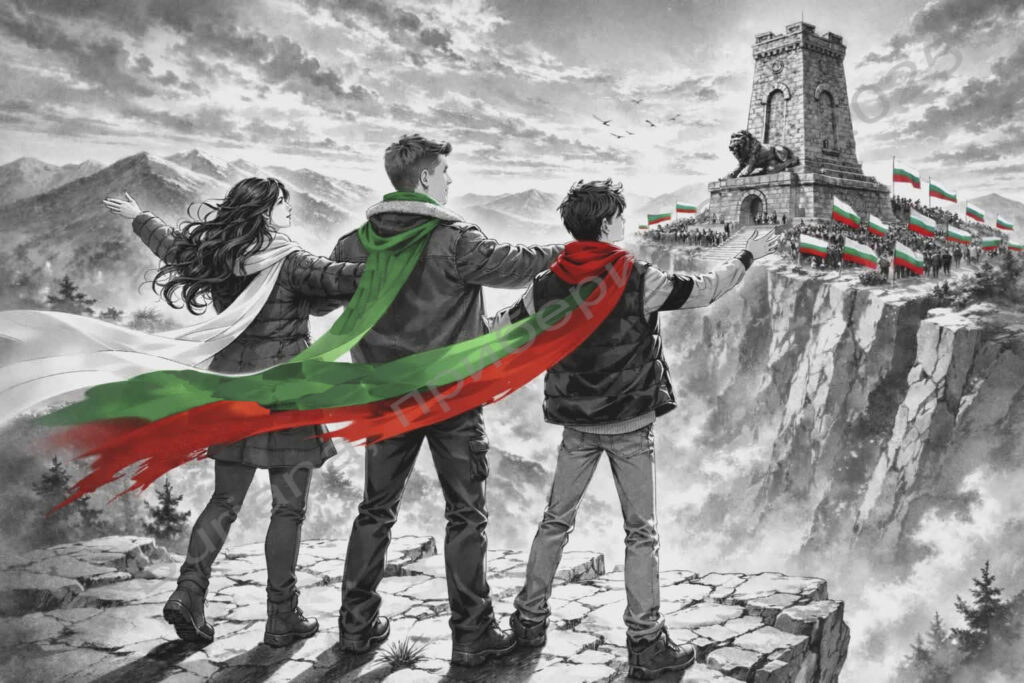
The three of them moved a little aside, looking down toward the ravines and up toward the eagle’s nests. From here they could see the monument, the crowd, and the endless folds of the mountain. Buryana gazed at the figure of the lion and imagined the carpet of bones beneath that earth, ours and foreign. Bulgarian volunteers, Russian soldiers, Finns, doctors, carriers, horses that had no other choice except freedom or death.
Simeon fixed his gaze on the distance:
– For them, freedom meant very concrete things. For no one to enter your house, set it on fire, or take your son. To be able to speak your own language without hiding. For the “foreigners” – it was not their land that was burning, and still they set out.
– You know – she said quietly, – sometimes it seems to me that the word “liberation” is so large that today we do not dare to touch it. I bow before this greatness. These people chose not to be spectators and “what can I do,” but to be “I am part of this.” Can you imagine that rare human maturity! They paid the price in advance with their readiness. To set out without knowing whether you will return means to part completely with the illusion of control. And most people die precisely from that: from the need to guarantee tomorrow before we have lived today. I bow before people who, in the hardest moment, do not think first of saving themselves. That is a boundary of the spirit that few cross. And there is something else, quieter, but for me the strongest. I bow before the fact that they created freedom they themselves did not see. That is love without a contract, without “you for me, I for you.” The kind that leaves a trace in the world and goes away without asking for applause.
Kin wiped away a tear and pressed the flag to himself.
– And what does it mean for us? – he asked. – Besides not parking sideways, I mean.
Buryana smiled.
– For us… – she thought. – I think freedom today is not to betray what they left us – not in the name of convenience, nor in the name of likes, and not to turn their memory into decor. Freedom is knowing when not to risk someone else’s life because of your ego. Not to forget that there is another freedom too – the inner one. Not to allow ourselves to become prisoners of fear, of noise, of eternal anger.
Kin turned to her.
– As I see it, people are still waging war, just with different weapons. Comments, statuses, television studios.
– Exactly because of that – Simeon hugged him – it is important that there are also people who do not wage war with everyone, but choose their battles. When I was your age, freedom was being able to say what you think without being taken away. Now it may be being able to keep your mouth shut when you have nothing to say, but your ego is still shouting.
The three of them were silent for a while. The wind passed through them and wove their scarves into one.
– You know – Buryana said, – I came here today with the feeling that freedom means “protecting my personal peace.” But on this peak I see that freedom is also being able to be proud that you are not indifferent, being able to choose where to push – a bus, a person, or your own ego. And that in your family there are people… – she looked at the two of them with a wide smile – with whom you can stand here like a proud volunteer fighter.
– All right – Kin nodded quietly. – I will take the duty to remember and to tell. You just make sure you don’t embarrass me.
– We will not embarrass you – Simeon laughed. – Our job is to be honest, and yours is to be free.
On the way down, Kin showed Buryana photos: a frame in which about ten people were pushing the bus, a girl with a large martenitsa helping an elderly woman climb the steps, an entire bundle of flags raised high and chasing each other across the sky with the wind, the enormous eagle wings above their heads.
– They are wonderful. If someone watches only the news, they will see speeches and wreaths. How beautiful that you see the Liberation this way! Keep these photos – Buryana said. – They are your personal history textbook.
That evening, when they got home, her body was pleasantly tired. She made herself tea, cut a piece of bread with cheese, the way her father used to do. Then she took out a martenitsa she had kept for herself from him and tied it carefully around her wrist.
– For the living and for the dead – she whispered. – And for those who died without knowing what would become of us. And for us, who have no right to live as if asleep.
She looked at her phone. The news was already overflowing with footage from Shipka, from the fireworks – speeches, laying of wreaths, official figures.
Buryana turned off the screen.
“I have my own memory and my own frames with the two men beside me” – she thought. – “And this peak, where freedom is not a word, but air.”
If you come across words in the text that are in color — they are links to additional materials on the site, related to similar topics.
“Quest to Self” – Q2S is an authorial method for inner transformation. It is not about an “artistic path,” but about a system with a clear structure, verifiable steps and practical actions that lead to lasting change, not temporary inspiration. Through Q2S, a person releases blocked energy and accumulated inner reactions in the subconscious, restores their nervous system and begins to create their reality consciously. If this touches you, you can explore how the process works in the “Quest to Self – Q2S” section.